The way people discover brands is undergoing a fundamental transformation. For two decades, Google dominated the discovery funnel – consumers typed queries, scanned ten blue links, and clicked through to websites. That model is now being disrupted by AI assistants that deliver direct, conversational answers with specific brand recommendations baked right in. If your brand isn't visible inside these AI-generated responses, you are already losing ground to competitors who are.
The Shift from Search Engines to AI Assistants
Traditional search engines present users with a list of links and leave the decision-making to them. A query like "best project management tool for remote teams" would return a results page filled with blog posts, review sites, and advertisements. The user then had to visit multiple pages, read through content, and form their own opinion.
AI assistants have turned this process on its head. When a user asks ChatGPT, Claude, or Gemini the same question, they receive a single, synthesized answer – often with a ranked list of specific brand recommendations, complete with reasoning for each. There are no links to click through, no ads to scroll past, and no second-page results to ignore.
This changes the dynamics in a profound way. AI responses carry implicit trust. Users treat them not as search results to be evaluated, but as expert recommendations to be followed. Research suggests that users are significantly more likely to try a product recommended by an AI assistant than one they find on a search engine results page, because the conversational format feels like getting advice from a knowledgeable friend rather than browsing a catalog.
"The brands that AI assistants choose to recommend are the brands that consumers will choose to buy. Visibility inside AI responses is becoming the new front page of the internet."
Consider the scale of this shift. Hundreds of millions of people now use ChatGPT, Claude, Gemini, and Perplexity on a regular basis. Every time someone asks an AI assistant for a product recommendation, a brand either wins or loses that micro-moment – and unlike traditional search, there is no "page two" to fall back on.
How AI Assistants Recommend Brands
Understanding how AI models decide which brands to mention is critical for any visibility strategy. These models are trained on massive datasets encompassing web articles, product reviews, technical documentation, comparison guides, forum discussions, and more. When a user asks a question, the model synthesizes everything it has learned to generate a response.
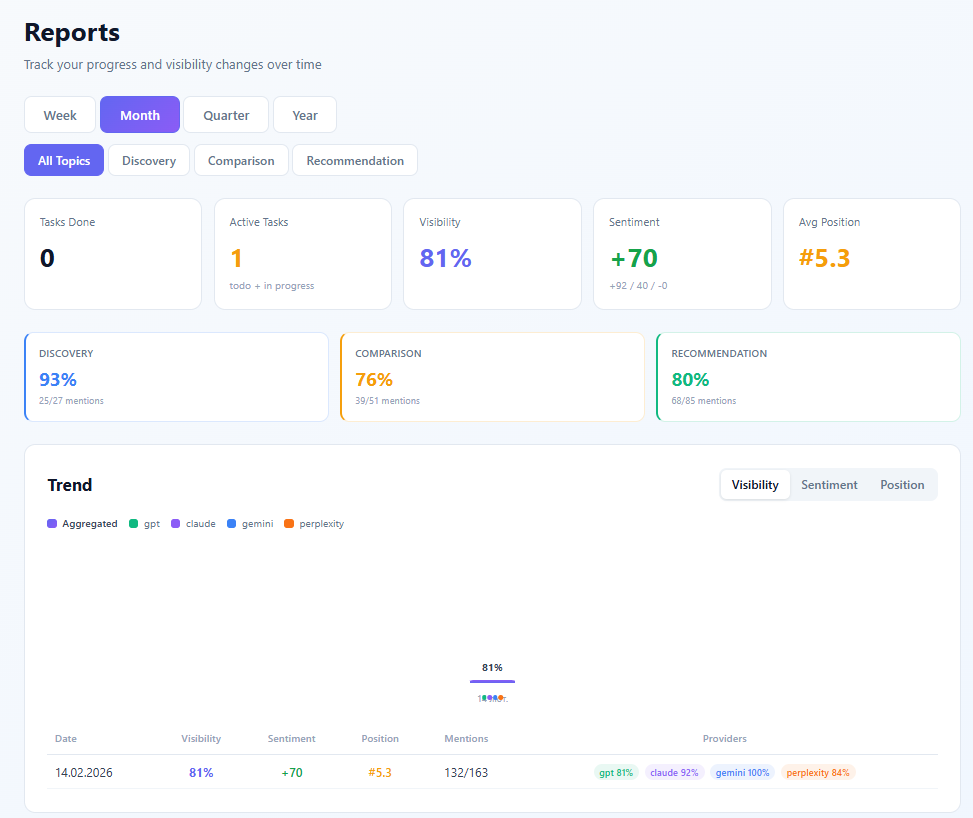
Not all prompts are created equal. At LLM Brand Boost, we categorize brand-relevant prompts into three distinct clusters, each representing a different stage of the customer journey:
Discovery Prompts
Discovery prompts are broad exploratory questions like "What tools exist for email marketing?" or "What are some CRM platforms?" These prompts cast the widest net and represent the top of the funnel. AI models typically respond with a comprehensive list of options, sometimes mentioning ten or more brands. Getting included in discovery responses means your brand enters the user's awareness set.
Comparison Prompts
Comparison prompts are more targeted: "Compare Mailchimp vs SendGrid vs ConvertKit" or "HubSpot vs Salesforce for small businesses." These prompts indicate the user is actively evaluating options and your brand's competitive positioning matters enormously. How the AI frames the comparison – which features it highlights, which trade-offs it mentions – directly influences the user's decision.
Recommendation Prompts
Recommendation prompts carry the highest conversion intent: "What's the best email marketing tool for a SaaS startup?" or "Which CRM should I use if I have a team of five?" When an AI names your brand as the top recommendation, that is a direct endorsement with measurable business impact.
Tip: Each prompt type requires a different optimization strategy. Discovery prompts reward broad web presence, comparison prompts reward detailed feature documentation, and recommendation prompts reward strong positive sentiment across authoritative sources.
The Numbers That Matter
Just as traditional SEO introduced metrics like keyword rankings, domain authority, and click-through rates, AI brand visibility introduces its own set of critical measurements. These are the numbers that determine whether your brand is winning or losing in the AI era:
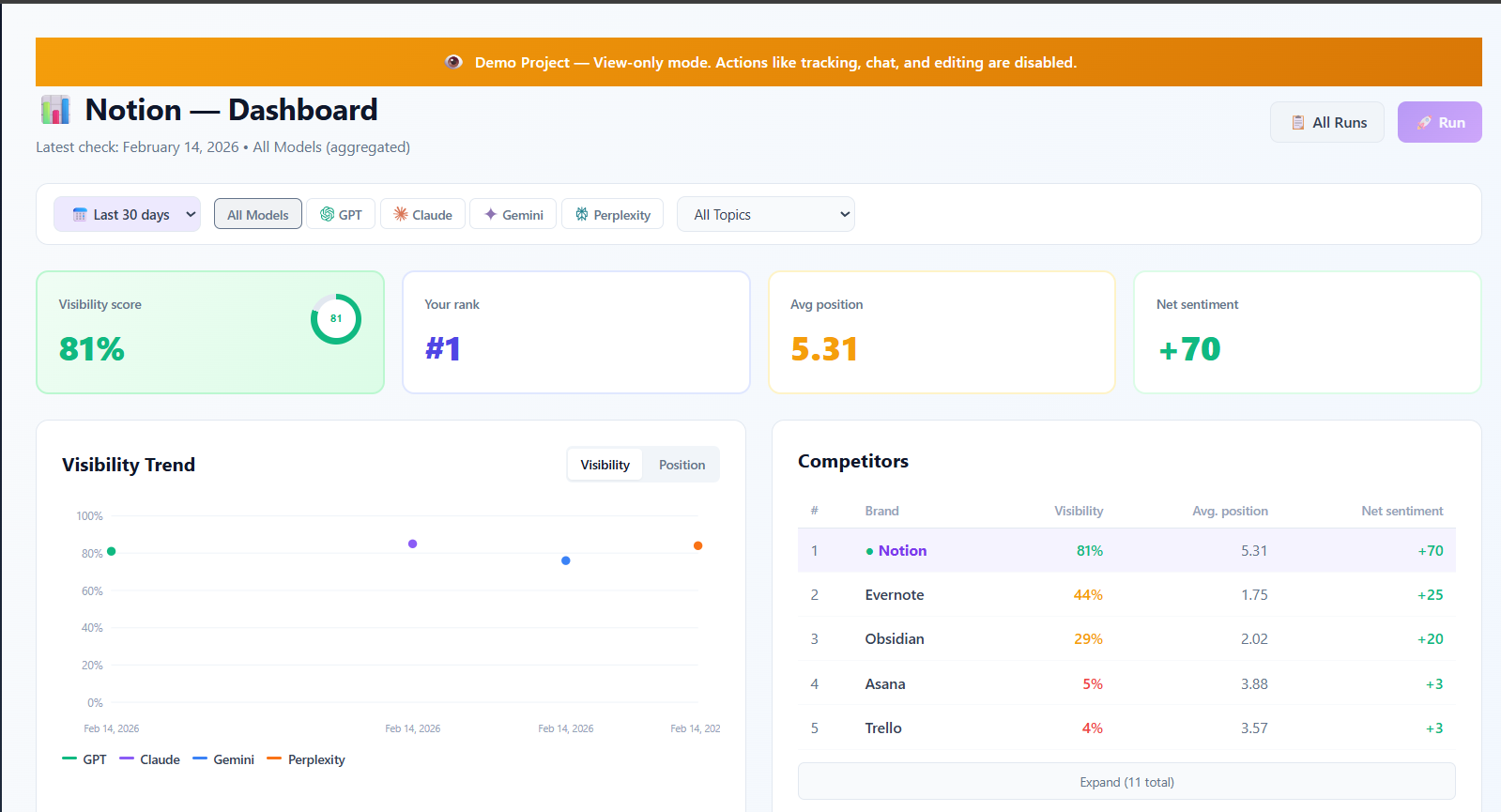
Visibility Score measures the percentage of relevant prompts in which an AI assistant mentions your brand. If there are 100 prompts related to your product category and your brand appears in 45 of the AI-generated responses, your visibility score is 45%. This is the foundational metric – if AI doesn't mention you, nothing else matters.
Average Position tracks where your brand appears in the AI's recommendation list. When an AI assistant lists five project management tools, being mentioned first is dramatically more impactful than being mentioned fifth. Position one captures disproportionate user attention and trust, much like the top organic result in traditional search.
Brand Sentiment analyzes how the AI describes your brand when it does mention you. Is the language positive ("powerful," "user-friendly," "industry-leading"), neutral ("available," "offers," "provides"), or negative ("limited," "expensive," "lacks")? Sentiment directly influences whether a mention translates into a customer or a lost opportunity.
Important: A high visibility score with negative sentiment can actually hurt your brand. Being mentioned frequently in a negative context – for example, "X is popular but has reliability issues" – is worse than not being mentioned at all. Always track visibility and sentiment together.
These three metrics together paint a complete picture of your AI brand health. They are now as important as traditional SEO rankings, and for many businesses, they are becoming even more important as consumer behavior continues to shift toward AI-first discovery.
Multi-Platform Reality
One of the most important – and often overlooked – aspects of AI brand visibility is that different AI platforms give different answers to the same question. ChatGPT, Claude, Gemini, and Perplexity are built by different companies, trained on different data, and use different reasoning approaches. This means your brand might be highly visible on one platform and virtually invisible on another.
Consider a practical example. A brand might achieve an 80% visibility score on GPT-5.2 because its content is well-represented in OpenAI's training data. But on Claude Sonnet, the same brand might only score 30% because Anthropic's model weighs different sources and prioritizes different qualities in its recommendations. On Gemini 2.0 Flash, which leverages Google's search index heavily, the picture could be different again. And Perplexity Sonar, which combines real-time web search with AI reasoning, introduces yet another variable.
This multi-platform divergence is why monitoring a single AI platform gives you an incomplete and potentially misleading picture of your brand's AI visibility. You need to track performance across all major providers to understand the full landscape.
LLM Brand Boost was built specifically for this multi-provider reality – and goes far beyond simple tracking. The platform monitors your brand across ChatGPT (GPT-5.2), Claude Sonnet, Gemini 2.0 Flash, and Perplexity Sonar simultaneously, giving you a unified dashboard to compare visibility, position, and sentiment. But the real power is what happens next: an AI Strategy Chat analyzes your data and builds actionable recommendations, a built-in to-do list tracks execution, and visual reports show whether your strategy is working – all from one mobile-friendly dashboard. No more jumping between a tracker, ChatGPT, and a project management tool.
Tip: Don't assume that strong visibility on ChatGPT means you're covered everywhere. Set up automated weekly tracking across all four platforms to catch discrepancies early and address them before they impact your pipeline.
What This Means for Your Brand Strategy
The rise of AI-powered brand discovery demands a fundamental rethinking of digital marketing strategy. Here are the key implications:
Content quality matters more than keyword stuffing. AI models are remarkably good at distinguishing genuinely useful content from SEO-optimized filler. The brands that AI recommends most consistently are those with comprehensive, well-structured, factual content that directly addresses user needs. Thin content designed to rank for specific keywords will not earn AI recommendations.
Being mentioned across authoritative sources increases AI recommendations. AI models cross-reference information from multiple sources. A brand mentioned positively in a single blog post has far less weight than a brand cited across industry review sites, expert comparisons, documentation portals, and user forums. The breadth and authority of your mentions matters enormously.
Positive reviews and sentiment directly influence AI's perception. AI models absorb and reflect the collective sentiment expressed about your brand across the web. A pattern of positive reviews, successful case studies, and favorable comparisons trains the AI to recommend you. Conversely, unresolved complaints, negative reviews, and poor press will surface in AI responses – sometimes explicitly.
Competitor monitoring reveals gaps and opportunities. In every product category, AI assistants typically recommend three to five brands. Understanding which competitors are being mentioned, in what position, and with what sentiment gives you the intelligence needed to compete effectively. If a competitor is consistently mentioned first in recommendation prompts while your brand appears third, you now have a clear and actionable target.
LLM Brand Boost's competitor tracking feature automates this intelligence gathering. You can monitor how AI positions your competitors across all four platforms, track changes in their visibility and sentiment over time, and identify the specific prompt clusters where they outperform you.
Getting Started
If you're new to AI brand visibility, here is a practical roadmap to get started:
- Track your current AI visibility across all major platforms. Before you can improve, you need a baseline. Measure your visibility score, average position, and sentiment on ChatGPT, Claude, Gemini, and Perplexity. LLM Brand Boost's automated weekly tracking makes this effortless.
- Analyze which prompt categories drive or miss your brand mentions. Use prompt clustering to understand whether your brand appears in discovery, comparison, or recommendation prompts – and where the gaps are. A brand that shows up in discovery prompts but disappears in recommendation prompts has a conversion-stage visibility problem.
- Monitor competitor positioning to identify strategic advantages. Set up competitor tracking to see how AI positions your rivals. Look for prompt categories where competitors are weak – these represent your best opportunities to capture AI mindshare.
- Use sentiment analysis to understand how AI perceives your brand. If your sentiment skews negative or neutral, investigate which sources are driving that perception. Source attribution helps you trace AI mentions back to the specific web content that influenced them.
Tip: Start with your top five most important product-category prompts and expand from there. Trying to optimize for hundreds of prompts at once is overwhelming. Focus on the prompts with the highest business impact first.
The shift from search engines to AI assistants is not a distant prediction – it is happening right now. Brands that recognize this shift early and invest in understanding their AI visibility will have a decisive advantage over those who wait. The question is not whether AI will change brand discovery. It already has. The question is whether your brand is ready.