What Is Brand Sentiment in AI?
When an AI model mentions your brand, it does far more than simply list your name. It wraps your product or service in descriptive language that carries a clear emotional tone. That tone – whether encouraging, indifferent, or cautionary – is what we call brand sentiment. It is the qualitative impression a large language model communicates about you to every person who asks.
Sentiment in AI responses falls into three broad categories. Positive sentiment includes language such as "highly recommended," "industry-leading," or "a reliable, feature-rich tool." Neutral sentiment is factual and measured – the AI acknowledges your brand without strong praise or criticism. Negative sentiment uses language like "has limited functionality," "users frequently report issues," or "not the best option for most teams."
Consider the difference between these two real-world AI outputs for the same brand:
"X is a reliable, feature-rich project management tool trusted by thousands of remote teams."
Compare that with:
"X has limited functionality compared to alternatives and has received mixed reviews for customer support."
Both responses mention the brand. But the first drives interest, while the second drives users straight to a competitor. LLM Brand Boost automatically classifies sentiment for every single prompt response across all tracked AI platforms – GPT-5.2, Claude Sonnet, Gemini 2.0 Flash, and Perplexity Sonar – so you always know exactly how AI is framing your brand.
Why AI Sentiment Matters More Than You Think
AI-generated recommendations carry an enormous amount of implicit trust. When a person asks ChatGPT or Perplexity for a product suggestion, they treat the response like advice from a knowledgeable friend. There is no list of ten blue links to scan, no ad labels to filter out. The AI speaks with a single, authoritative voice – and users listen.
This dynamic means that negative sentiment in an AI response can turn away potential customers instantly. Unlike a bad review buried on page two of Google, a negative AI response is the entire answer. There is nothing else on the page competing for attention. The user reads it, accepts it, and moves on to the brand the AI actually endorsed.
On the other hand, positive sentiment is essentially a free endorsement from what users perceive as a trusted, objective authority. When AI describes your product as "the best option for small teams" or "known for exceptional reliability," that single statement can drive more qualified traffic than an entire ad campaign.
Early data shows that sentiment directly correlates with conversion from AI-referred visitors. Users who arrive at your site after a positive AI mention convert at significantly higher rates than those who find you through traditional search. The reason is simple: they arrive pre-sold. The AI already told them you are worth checking out.
How LLM Brand Boost Tracks Sentiment
Automatic Classification
Every time LLM Brand Boost sends a prompt to an AI platform and receives a response that mentions your brand, that response is automatically analyzed for sentiment. There is no manual tagging or subjective guesswork involved. The system classifies each mention into one of three categories:
- Positive – The AI uses language that endorses, recommends, or praises your brand
- Neutral – The AI mentions your brand factually without strong positive or negative framing
- Negative – The AI uses language that criticizes, warns against, or unfavorably compares your brand
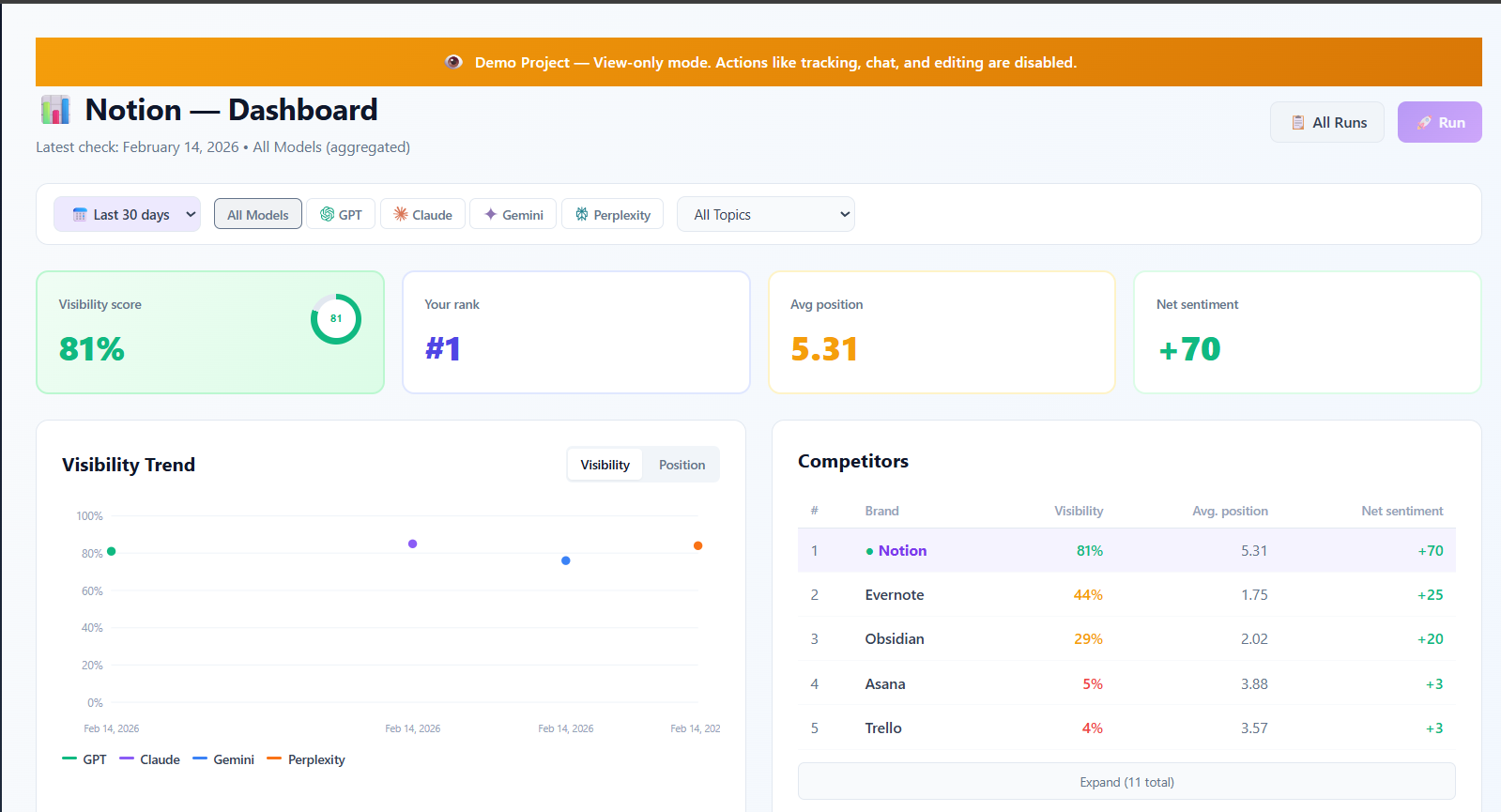
These individual classifications are then aggregated into an overall sentiment score across all your prompts. You can see at a glance whether AI perception of your brand is trending positively, holding steady, or declining – and drill into specific responses to understand exactly what is driving the score.
Sentiment by Prompt Cluster
Not all prompts are created equal. LLM Brand Boost groups prompts into three clusters, and sentiment can vary dramatically between them:
- Discovery prompts – These are questions from users who have never heard of your brand. Sentiment here determines the critical first impression AI creates. A positive introduction opens the door; a negative one slams it shut before the user even visits your site.
- Comparison prompts – Users actively weighing you against competitors. Sentiment in comparison responses reveals how AI positions you relative to alternatives. Being mentioned but described negatively is often worse than not being mentioned at all.
- Recommendation prompts – Users asking AI to pick the best option. This is where sentiment has the most direct impact on revenue. Does AI actively endorse your product, or does it recommend you with caveats and reservations?
By breaking sentiment down by cluster, you can identify exactly where your brand perception needs work. You might discover that AI introduces you positively to new users but consistently favors a competitor in head-to-head comparisons.
Sentiment Across AI Platforms
One of the most surprising findings from multi-provider tracking is that the same brand can have dramatically different sentiment on different AI platforms. GPT-5.2 might describe your product as "a top choice for enterprises," while Claude Sonnet says "a decent option but not without limitations." Gemini 2.0 Flash might be enthusiastically positive, while Perplexity Sonar takes a measured, neutral tone.
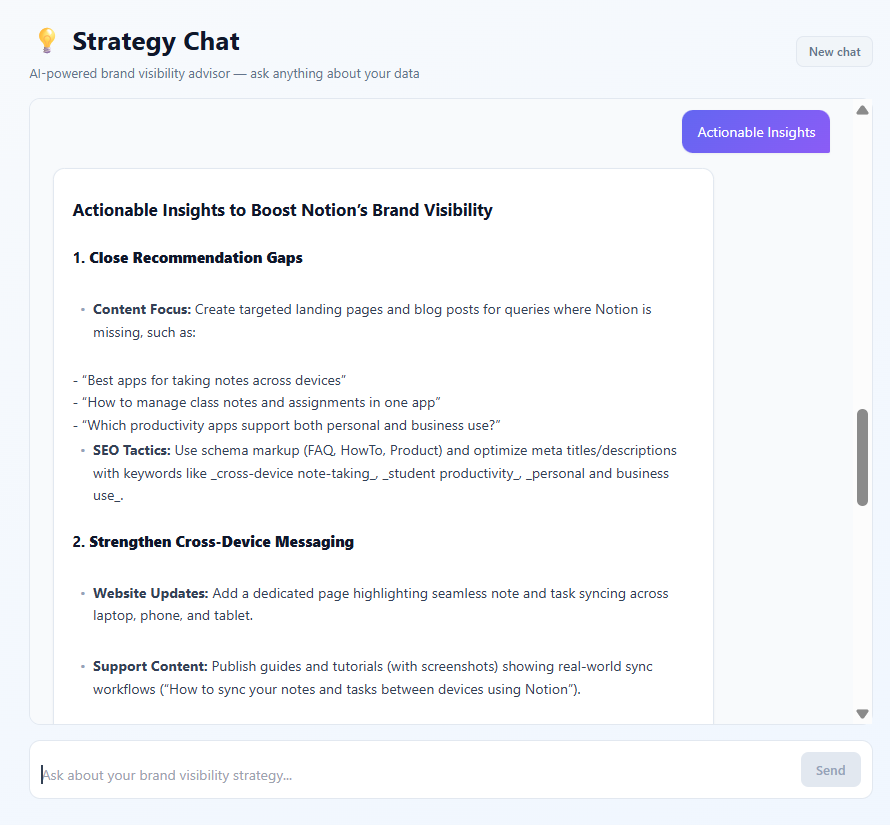
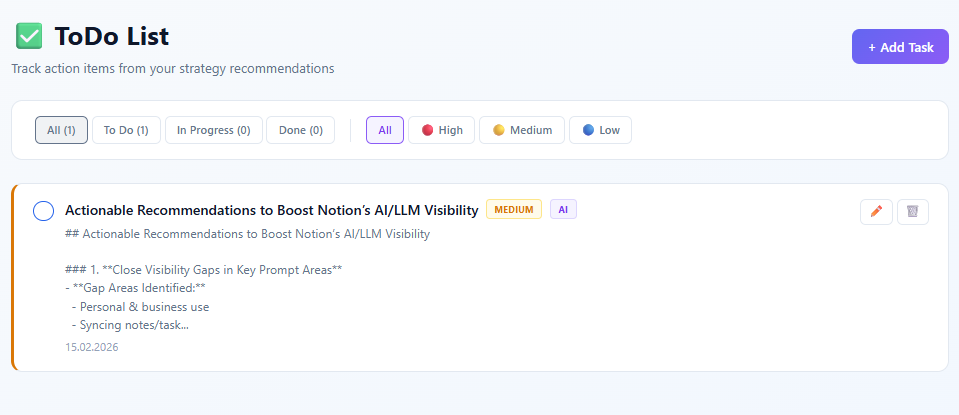
These discrepancies arise because each platform uses different training data, applies different reasoning approaches, and weighs sources differently. LLM Brand Boost tracks sentiment independently for each provider, giving you a complete picture of how your brand is perceived across the AI ecosystem. But it doesn't stop at data: the platform's AI Strategy Chat can analyze your actual negative and positive mentions with their full context, suggest specific actions to improve sentiment, and add them to your built-in to-do list – so you go from "sentiment is negative" to "here's what to do about it" in one session.
Common Causes of Negative AI Sentiment
If you discover that AI has a negative perception of your brand, the cause almost always traces back to the information available in the model's training data. Here are the most common culprits:
- Outdated negative reviews dominating training data – Problems you fixed years ago may still define how AI sees you, because the complaints were written, indexed, and absorbed before you shipped the fix.
- Unresolved customer complaints on public forums – Unanswered threads on Reddit, Stack Overflow, or community forums signal to AI that issues are systemic and ignored.
- Negative press coverage or controversy – A single viral article about a data breach, pricing backlash, or executive controversy can shape AI perception for years.
- Poor product documentation leading to confusion – When AI cannot find clear information about your product's capabilities, it may infer limitations or generate hedging language.
- Competitor comparison content that positions you unfavorably – If competitors publish "Brand X vs. Us" pages that rank well, AI absorbs that framing and echoes it back to users.
Strategies to Improve Brand Sentiment
1. Audit Your Public Presence
Before you can improve sentiment, you need to understand what is driving it. Start with a thorough audit:
- Search for your brand + "review," "complaint," and "problem" on Google. The results you find are likely in AI training data.
- Use LLM Brand Boost to check what AI currently says about your brand across all four platforms. Run discovery, comparison, and recommendation prompts to get a complete picture.
- Identify the specific negative narratives that appear repeatedly. Is it pricing? Reliability? Customer support? Knowing the pattern tells you exactly what to address.
2. Publish Positive Proof Points
AI models rely on the balance of positive and negative information available. You can shift that balance by creating authoritative, positive content:
- Case studies with specific metrics and results – Not vague testimonials, but concrete numbers. "Reduced deployment time by 60%" is the kind of data AI picks up and cites.
- Customer testimonials from recognizable companies – Brand-name customers add credibility. AI models assign higher weight to information from authoritative sources.
- Awards, certifications, and industry recognition – Third-party validation is extremely powerful for shaping AI perception because it comes from independent, trustworthy sources.
3. Address Negative Content
Ignoring negative content does not make it disappear from AI training data. Take an active approach:
- Respond publicly to negative reviews – A thoughtful, professional response to criticism demonstrates accountability and often changes the narrative entirely.
- Publish updates that address known issues – If customers complained about a missing feature and you have since built it, make sure that information is publicly visible and well-indexed.
- Create "myth vs. reality" content for common misconceptions – If AI is repeating outdated criticisms, publish clear, factual content that directly counters those narratives.
4. Build a Consistent Positive Narrative
Consistency matters. AI models synthesize information from dozens or hundreds of sources. If your messaging is fragmented or contradictory, the AI has no clear story to tell:
- Ensure messaging is consistent across all channels – Your website, documentation, social media, review responses, and press should all reinforce the same core strengths.
- Focus on unique strengths and differentiators – Generic claims get lost. Specific, unique value propositions are more likely to be picked up and repeated by AI.
- Maintain an active, positive presence on review platforms – Encourage satisfied customers to leave reviews. A steady stream of recent positive reviews signals to AI that your product is well-regarded and improving.
Tracking Sentiment Over Time
Improving brand sentiment in AI is not a one-time effort. It requires ongoing monitoring and consistent action. LLM Brand Boost provides several tools to make this manageable:
- Use the visibility history chart to monitor sentiment trends – The chart shows how your sentiment score changes week over week, making it easy to spot improvements or regressions.
- Filter by sentiment in the prompt results table – Drill into specific positive, neutral, or negative responses to understand exactly what AI is saying and why.
- Set up weekly automated tracking to catch sentiment changes early – Automated tracking runs your prompts across all four AI platforms every week, so you never miss a shift in perception.
Tip: Sudden sentiment drops often correlate with new negative content appearing online. Use weekly tracking to detect changes early, then investigate what new content may be influencing AI perception. The faster you identify and address the source, the sooner sentiment recovers.
Brand sentiment in AI responses is one of the most powerful and least understood forces shaping how customers discover and evaluate your product. The brands that monitor and actively manage their AI sentiment today will have an enormous advantage as AI-powered search becomes the default way people find solutions. Start tracking your sentiment across ChatGPT, Claude, Gemini, and Perplexity – and take control of the narrative before your competitors do.