When an AI assistant recommends your brand, that recommendation did not appear from thin air. It was built from specific web sources – articles, reviews, documentation, forum posts, and comparison guides that the AI model absorbed during training or retrieved in real time. Understanding which sources drive AI to mention your brand is one of the most powerful and underutilized levers in AI brand visibility. Source attribution turns the black box of AI recommendations into an actionable, strategic asset.
AI Doesn't Make Things Up (Usually)
There is a common misconception that AI models generate recommendations from nothing – that their suggestions are arbitrary or random. In reality, AI recommendations are grounded in real web sources. Every brand mention, every product comparison, every recommendation an AI makes is shaped by the vast corpus of content it was trained on or retrieved during inference.
Certain platforms make this relationship explicit. Perplexity Sonar cites its sources directly in every response, linking users to the exact articles, review pages, and websites that informed its answer. When Perplexity recommends your brand as the best CRM for small teams, it shows the user exactly which G2 review, which TechCrunch article, and which comparison blog post led to that recommendation. This transparency is invaluable for understanding what drives AI mentions.
Other platforms – ChatGPT (GPT-5.2) and Claude Sonnet – implicitly rely on authoritative content baked into their training data. They do not cite sources in their responses, but their recommendations are nonetheless shaped by the web content they absorbed. A brand that appears positively across dozens of authoritative publications will be recommended more consistently than a brand with a thin web presence, even though the AI does not explicitly say "I'm recommending this because of article X on website Y."
Gemini 2.0 Flash sits in between – it leverages Google's search index and can draw from real-time web data, blending training knowledge with live search results. This means the freshness and search-engine visibility of your content directly influence what Gemini says about your brand.
The key insight is this: understanding which sources influence AI = understanding how to improve your visibility. Source attribution gives you a roadmap. Instead of guessing at why AI mentions your competitor more often, you can see exactly which websites, articles, and reviews are driving those mentions – and then take strategic action to close the gap.
What Are AI Sources?
Domains vs URLs
Source attribution operates at two levels, and both provide distinct strategic value.
Domain-level attribution shows which publications and websites influence AI's knowledge of your brand. For example, "forbes.com mentioned 5 times" tells you that Forbes is a significant source driving AI to talk about your brand. Domain-level data reveals the overall media landscape that shapes your AI presence – which review sites, industry blogs, and publications matter most.
URL-level attribution drills deeper to show which specific pages drive mentions. For example, "forbes.com/best-crm-tools-2026" tells you not just that Forbes matters, but that one particular article on Forbes is the content AI is drawing from. URL-level data is the most actionable – it tells you exactly which pages to update, which articles to seek inclusion in, and which competitor content to study.
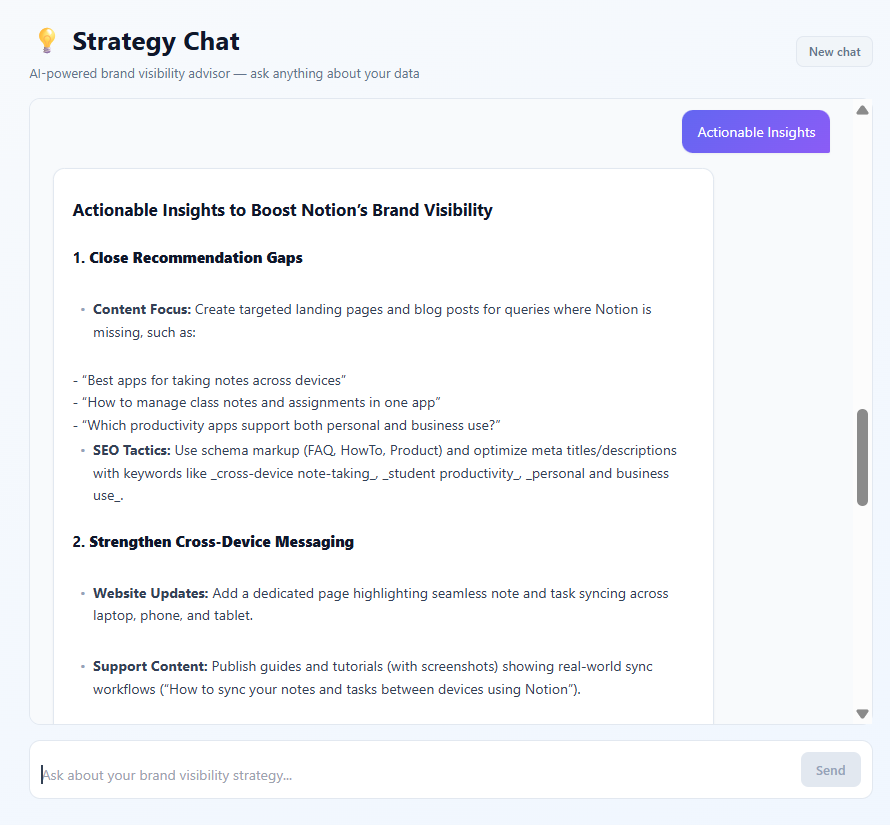
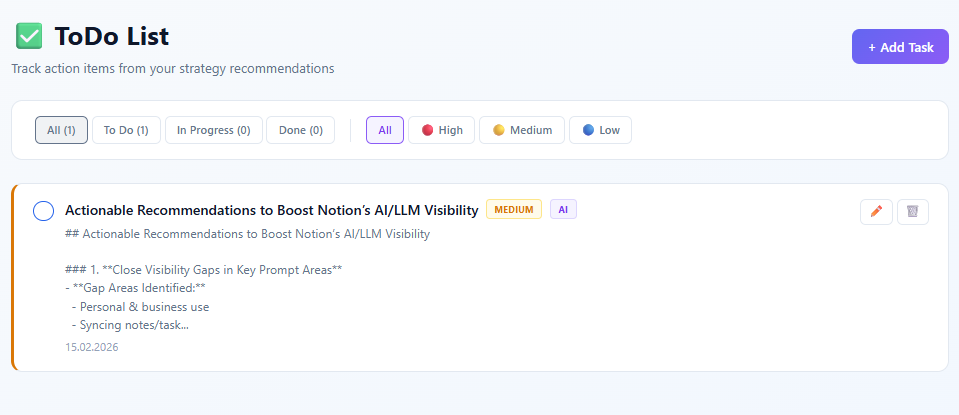
LLM Brand Boost tracks both levels automatically. After each tracking run, you can see the complete source profile for your brand and your competitors, broken down by domain and URL, filtered by AI platform. Then use the AI Strategy Chat to analyze which sources matter most, get recommendations for where to focus your content efforts, and add specific action items to your built-in to-do list – turning source data into an executable strategy.
Source Types That Influence AI
Not all sources carry equal weight in AI's recommendation engine. Understanding which source types have the most influence helps you prioritize your content and outreach strategy.
- Review platforms (G2, Capterra, TrustPilot, etc.): These are among the most heavily weighted sources for AI recommendations. AI models treat verified user reviews as strong signals of product quality and fit. A well-maintained profile with positive reviews on G2 or Capterra can significantly boost your AI visibility.
- Industry publications and blogs: Articles from recognized industry publications carry authority. Being featured in or cited by publications that AI models consider authoritative strengthens your brand's perceived credibility.
- Product documentation and help centers: Your own documentation is a source too. Comprehensive, well-structured docs help AI models understand your product's capabilities, features, and use cases in detail.
- Comparison and "best of" articles: Roundup content like "The 10 Best Project Management Tools" is heavily referenced by AI when answering recommendation and discovery prompts. Inclusion in these articles has outsized impact on AI visibility.
- Social media and forums (Reddit, Quora): User discussions on Reddit threads and Quora answers provide sentiment signals and real-world use-case data that AI models absorb. Positive organic mentions in relevant subreddits or Quora threads contribute to favorable AI recommendations.
- Wikipedia and knowledge bases: AI models treat Wikipedia and similar structured knowledge sources as authoritative references. If your brand has a Wikipedia entry, keeping it accurate and current is an important AI SEO activity.
How LLM Brand Boost Tracks Sources
The Sources Page
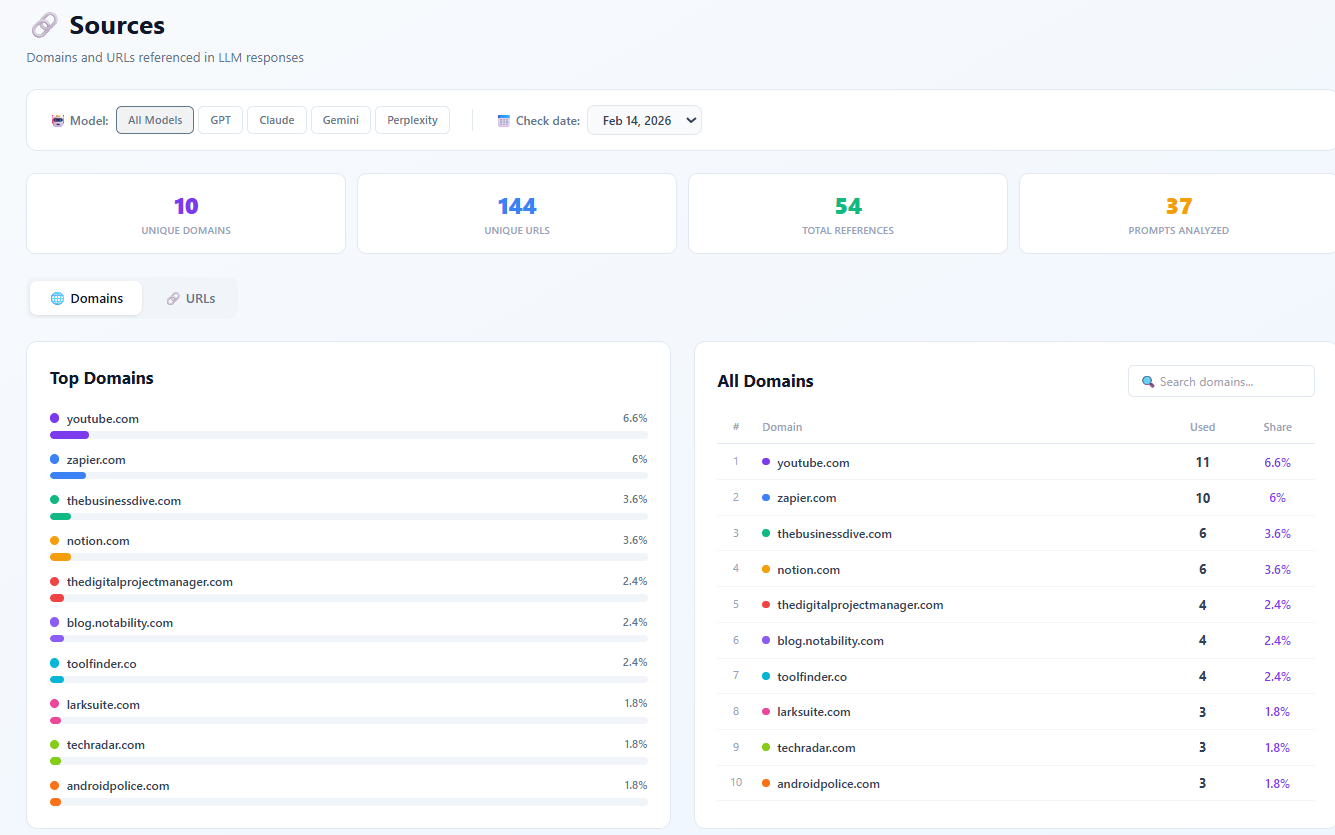
After each tracking run, LLM Brand Boost analyzes the AI responses and extracts every URL and domain referenced – both explicitly cited (as in Perplexity responses) and contextually identified from the response content. The Sources page presents this data in an organized, filterable view that makes strategic analysis straightforward.
On the Sources page, you can see which domains appear most frequently in AI responses mentioning your brand. You can filter by AI model to understand platform-specific source differences – for example, discovering that Perplexity draws heavily from TechCrunch while ChatGPT seems more influenced by G2 reviews. You can also compare source profiles across brands, revealing which sources drive mentions for your competitors that you are absent from.
Source Metrics
LLM Brand Boost provides several key metrics for understanding your source landscape:
- Unique domains: How many different websites influence your AI presence. A higher count generally indicates a broader, more resilient source profile – your AI visibility is not dependent on a single publication.
- Domain frequency: Which domains appear most often across tracking results. High-frequency domains are your most important sources – they are the foundation of your AI visibility and should be prioritized for maintenance and optimization.
- URL count: Total specific pages referenced across all tracking responses. This gives you a sense of the depth of your source coverage – are AI models drawing from one page on a site or multiple pages?
- Per-prompt source breakdown: See exactly which sources AI used for each individual response. This granular view lets you trace specific AI mentions back to the exact content that influenced them, creating a clear cause-and-effect relationship between your content strategy and AI outcomes.
Strategic Source Analysis
Finding Your "AI Backlinks"
In traditional SEO, backlinks – links from other websites pointing to yours – are a primary ranking factor. AI SEO has an analogous concept: the web sources that train AI to mention and recommend your brand. We call these "AI backlinks," and they are every bit as important for AI visibility as traditional backlinks are for search rankings.
Tip: Think of sources as "AI backlinks" – the more quality sources mention your brand positively, the more likely AI will recommend you. A strong AI backlink profile means your brand is cited across multiple authoritative domains with positive sentiment, giving AI models consistent, high-quality signals to draw from.
Start by auditing your current source profile on the LLM Brand Boost Sources page. Identify which domains are currently driving your AI mentions. Are they authoritative? Are the specific pages current and accurate? A source profile dominated by a single outdated blog post is fragile – if that content becomes stale or is removed, your AI visibility could drop significantly.
Identifying Source Gaps
One of the most powerful applications of source attribution is comparative analysis. By comparing your source domains with your competitors' source domains, you can identify exactly where your AI backlink profile has gaps.
Are competitors featured on authoritative review sites where you have no presence? Do they have in-depth listings on Capterra or G2 while your profiles are incomplete or missing? Are they cited in major "best of" roundup articles that do not include your brand? Each of these gaps represents a concrete, actionable opportunity to improve your AI visibility.
Prioritize closing gaps on high-influence domains first. Getting featured on a single authoritative publication that AI models rely on heavily can have more impact than creating ten new blog posts on your own site. Source gap analysis turns vague "we need better AI visibility" goals into specific, measurable action items.
Platform-Specific Sources
Different AI platforms weigh sources differently, which is why tracking source attribution per platform is essential.
Perplexity Sonar is the most transparent – it explicitly cites sources in every response, showing users exactly which web pages informed the answer. This makes Perplexity the ideal platform for understanding source-response relationships. It is also the platform where content freshness has the greatest impact, since Perplexity retrieves sources from live search results.
Gemini 2.0 Flash is heavily influenced by Google's search index. Domains and pages that rank well in Google Search tend to appear more frequently as sources in Gemini's responses. This creates a strong overlap between traditional SEO performance and Gemini source attribution – investing in search rankings directly improves your Gemini source profile.
ChatGPT (GPT-5.2) and Claude Sonnet have sources baked into their training data. These sources are harder to track directly since the models do not cite them, but the patterns are consistent – brands with broad, authoritative web presence across multiple high-quality domains consistently outperform those with narrow source profiles. LLM Brand Boost uses contextual analysis to identify likely source domains even for these platforms.
Building a Source Strategy
1. Audit Current Sources
Begin with a clear picture of your existing source landscape. Run a tracking cycle in LLM Brand Boost and review the Sources page. Identify your top domains and URLs. Ask yourself: Are these sources authoritative? Are the specific pages current? Do they represent your brand accurately and positively? This audit establishes your baseline and reveals both strengths to leverage and weaknesses to address.
2. Target High-Value Sources
Based on your audit and competitor source gap analysis, build a prioritized list of high-value sources to target. Focus on:
- Industry-specific review sites: If G2, Capterra, or TrustPilot appear frequently in your competitors' source profiles, ensure your profiles there are complete, current, and actively gathering reviews.
- Authoritative comparison blogs: Seek inclusion in respected roundup and comparison articles in your vertical. Reach out to bloggers and journalists who write these pieces – a single feature in a high-authority comparison article can meaningfully boost your AI visibility.
- Major publications in your vertical: Industry publications carry significant weight in AI training data. Guest posts, expert quotes, case study features, and product reviews in these publications all contribute to a stronger source profile.
- Product directories and marketplaces: Platforms like Product Hunt, AlternativeTo, and category-specific directories serve as discovery sources for AI models. Maintaining active, well-optimized listings on these platforms improves your discoverability.
3. Create Source-Worthy Content
The most sustainable source strategy is creating content that other sites want to reference. When your content becomes a source for others, it amplifies your AI visibility through a multiplier effect.
- Publish data-driven research and reports. Original data, industry benchmarks, and research findings are frequently cited by other publications. When a major blog references your annual industry report, that reference becomes part of AI's source landscape for your brand.
- Create comprehensive guides that others want to reference. In-depth, authoritative guides become go-to references that other content creators link to and cite. This builds your source profile organically over time.
- Maintain updated, accurate product documentation. Your documentation is not just for customers – it is a source that AI models rely on to understand your product. Detailed, well-organized docs help AI accurately describe your features, capabilities, and use cases.
4. Monitor Changes Over Time
Source attribution is not static. As new content is published, old content becomes stale, and AI models are retrained, your source profile evolves. Continuous monitoring is essential for maintaining and improving your source strategy.
- Set up weekly tracking to see source attribution changes. LLM Brand Boost's automated tracking captures source data with every cycle, making it easy to spot trends and shifts.
- New sources appearing = growing influence. When new domains start appearing in your source profile, it means your content strategy is working – new publications and websites are mentioning your brand in ways that AI models are picking up.
- Sources disappearing = content becoming outdated. When previously active source domains drop out of your profile, it typically means the underlying content has become stale, been removed, or been superseded by fresher competitor content. This is a signal to update or replace that content.
Warning: If your main source domains are outdated or low-authority, AI may stop relying on them. Keep your key source content fresh and updated. A source profile built on articles from 2022 will steadily lose influence as AI models are retrained on newer data. Regularly refreshing your most important source content protects your AI visibility over time.
The Virtuous Cycle
Source attribution creates a powerful feedback loop that compounds over time. Better sources lead to more AI mentions. More AI mentions increase your brand's visibility and authority. Greater visibility drives more traffic to your website and products. More traffic attracts more coverage from publications, review sites, and bloggers – creating new sources that further strengthen your AI presence.
This virtuous cycle means that early investment in source strategy has compounding returns. The brands that build strong source profiles now will be progressively harder to displace as their influence grows across the AI landscape. Conversely, brands that ignore source attribution will find the gap widening as competitors accumulate source advantages that reinforce themselves over time.
Source attribution tracking closes the loop in this cycle. Without it, you are investing in content and outreach blindly, hoping it translates into better AI visibility. With it, you see exactly which investments are paying off – which new articles drove increased mentions, which review sites contributed to improved sentiment, which comparison guides boosted your position in recommendation prompts. Each tracking cycle reveals cause and effect, letting you double down on what works and redirect effort away from what does not.
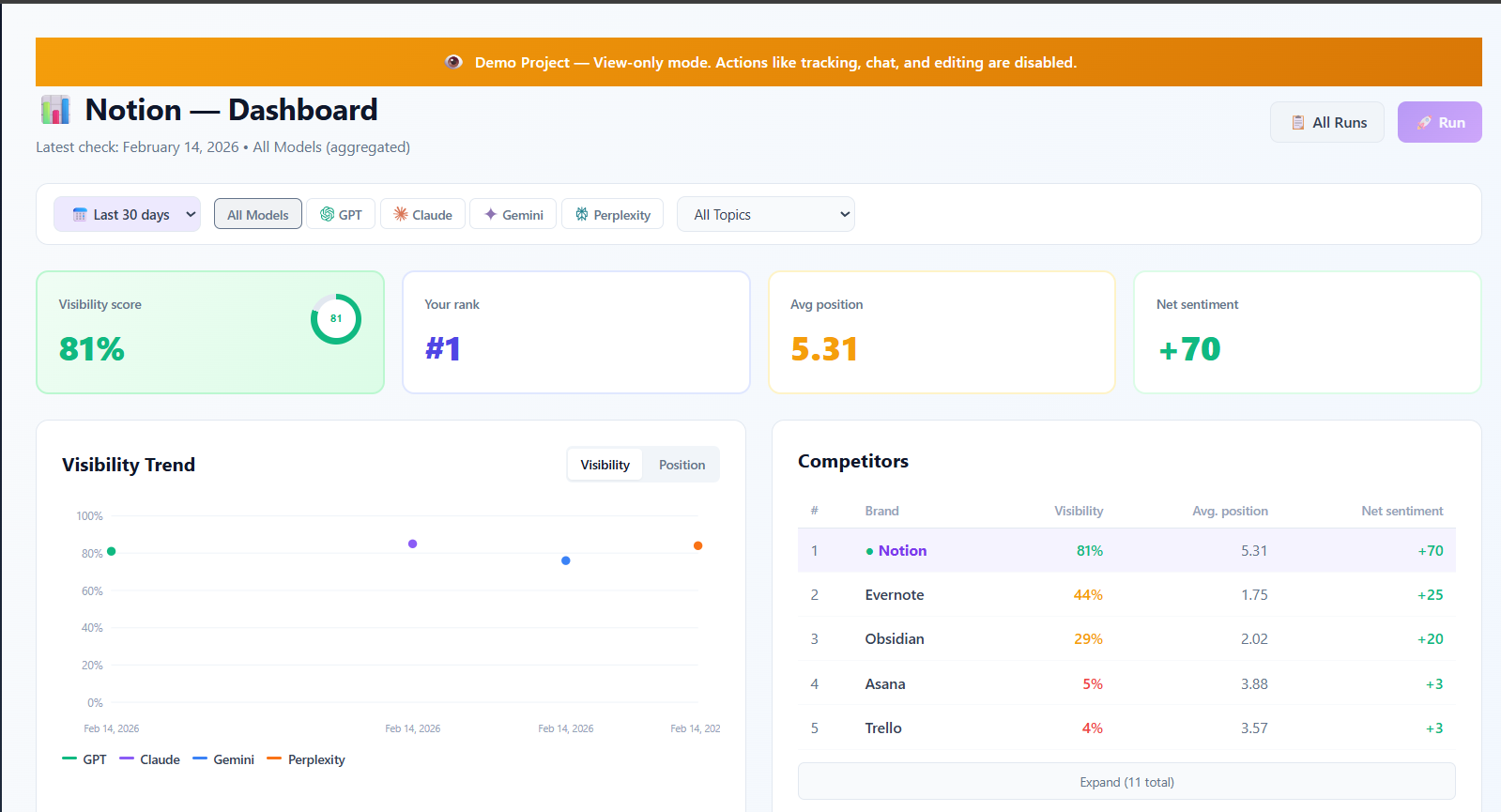
The bottom line: in AI SEO, sources are your foundation. Your visibility score, position ranking, and brand sentiment are all downstream of the sources that AI models rely on to form their understanding of your brand. Monitoring, analyzing, and strategically building your source profile is not a secondary activity – it is the engine that drives every other AI visibility metric. Start tracking your sources today, and you start controlling the narrative that AI tells about your brand tomorrow.